
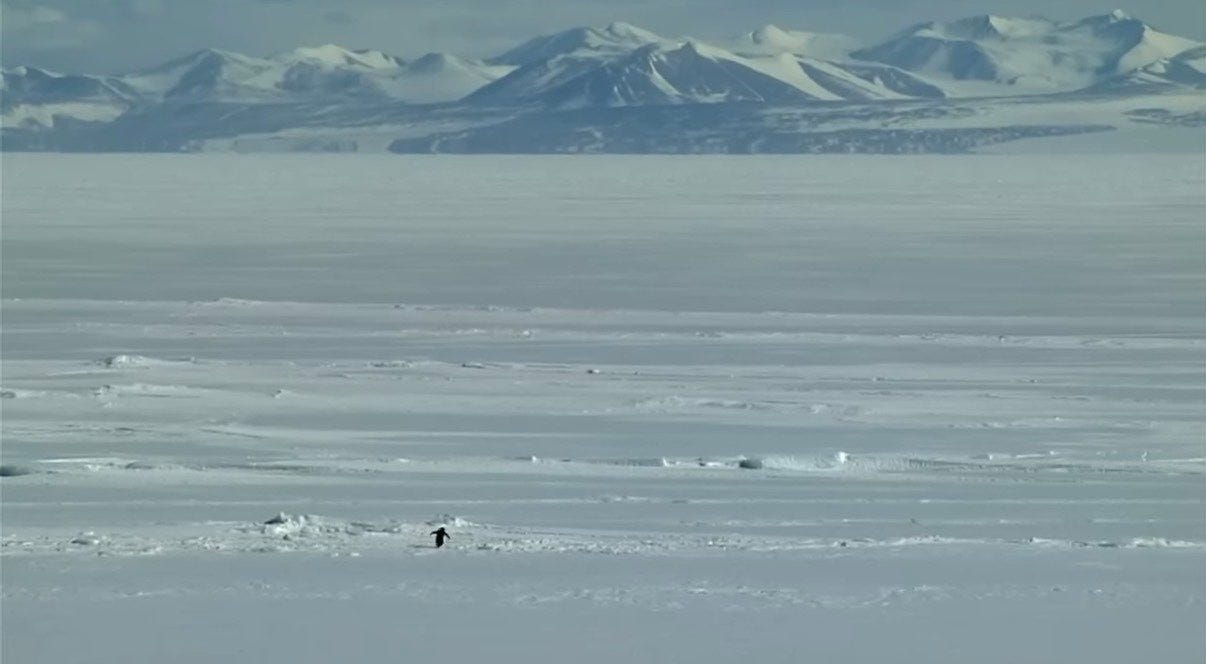
Recently, a clip from a Werner Herzog’s Encounters at the End of the World has become a central topic of discussion. In the clip, Werner Herzog asks a scientist if he has ever seen a penguin go crazy. The scientist responds that he hasn’t seen a penguin do some of the things that we typically associate with insanity, but that the penguins can get, “disoriented,” and that you will find them in places that they are not supposed to be. The film then proceeds to show one of these penguins running off towards the Antarctic mountains where he will find no means of survival.
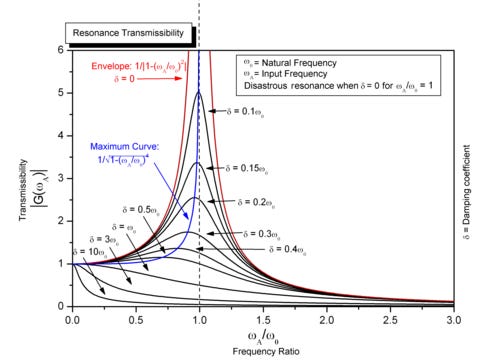
I remember seeing this clip a while ago, so it was interesting to see it reappear into the public consciousness. The question that I usually come to when something that has been around for a while suddenly gain traction is, “Why now and not earlier?” I believe that things like Werner Herzog’s penguin become memetic once the collective consciousness becomes saturated enough with an attitude or thought that resonates with that thing. It is as if there is a resonance frequency of the collective consciousness and that meme is resonating at a similar frequency. Then all of a sudden, like a wine glass being bombarded with its resonance frequency, it explodes.
While we like to laugh about memes and a lot of people do not seem to take them seriously, the concept of a, “meme,” or, “sociocultural replicator1,” is a serious concept. Memes have always existed; however, the internet has accelerated the replication process. A meme in the pre-internet era may have initially started in a small town paper, then propagated to a larger city nearby and then possibly to a national or international level. However, memes do not necessarily have to be national or international to be valid memes. One could argue that things like inside jokes are just memes at the microscopic level.
Back to our question, “Why is Werner Herzog’s Penguin a meme now?” The advent of extreme technological acceleration has left many of us disoriented and wondering where we really are. While technocrats are gushing over the profits that they might be able to make if artificial intelligence takes off2, we are stuck with the more practical questions of whether we will have meaningful work to do five years from now. I tend to think that AI is in a massive bubble right now and cannot really deliver what a lot of these technocrats are promising3; however, that doesn’t detract from the fact that a vocal and powerful group of people are saying that you won’t have a job in a decade. Furthermore, AI is just one recent technological innovation, in a long line of technological innovations that have contributed to substantial sociocultural disorientation.
People are beginning to ask the very real questions of, “Where we are collectively ‘going’?” We all sit in some degree of a collective delusion. We like to believe that we are totally in control of what we think, what we like, what we believe; but, we are people that live in a collective and many times that collective seeps into our self. This fact is not an inherently bad thing; many times this process is how we learn beneficial concepts. Additionally, a society cannot function properly with a set of purely “free” individuals.
But there come points when we really need to consider if we are all walking off a cliff as lemmings. We have to process whether we actually agree with the values or methods of society and whether what we think are our values, are actually our values. I think that given the breadth of uncertainty, it is difficult to characterize how exactly it manifests for every individual. We are all noticing different aspects of the problem, but the feeling that we share is universal. That instinct or urge to reject that collective process or value is what resonates about the penguin. We are all looking at these things and saying to ourselves, “It might be time to run to the mountains.” To the collective, it might look like insanity; it might look like extreme disorientation; but in reality, it is simply a fight to regain the self. It is saying that what everyone else is doing is not an obligation.
As you can probably guess, the aspect of this problem that I am mainly processing is with AI. Again, I have my personal doubts on AI’s capabilities4, but what I am more concerned about is this mentality that this AI world is really what we want. We are navigating around this dark, narrow passage with no real light and being told that at some point we are going to find paradise.
Ultimately, what the AI technocrats want us to believe is that we want a world without struggle. On the surface level, this sounds appealing; however, we would not be able to function without struggle. We need some kind of overcoming to grow. A world without struggle would create a stagnant mess, if not, one proliferated with absolute insanity.
We need to recognize that what these people want is not what we want. These are people who live inside of their own heads in crazy, artificial worlds entirely of their own concoctions. Maybe Dario Amodei wants to live in a world where Claude orchestrates shrimp-farm nirvana5, but I am fairly certain that no one else really sees the world that way. People might say things along those lines, but in reference to what I talked about earlier, this value is of a collective origin, not a personal one. People think that is what they want, but if they were to actually play out that reality, they would go insane. What people resent is meaningless work, which unfortunately has become rampant in the last couple of decades. While AI does reduce a degree of meaningless work, it also has the potential to remove most of the meaningful work—at least if we are to believe the AI technocrats6.
What we are building right now is a future for an empty face7. A reality for a person that doesn’t exist and will never exist. Unfortunately, we are being pulled along in a form of technological inertia that will be difficult to stop. We are that penguin, looking around, getting all disoriented, and running to the mountains. But we aren’t running to nothingness.
At this point, we are really only talking about AI in the context of Large Language Models (LLMs) which are not “intelligent” in the way that something like Artificial General Intelligences (AGIs) would be. The good thing for us is AGI does not exist at the present moment. There is some good debate on whether AGI is even possible.
I am referring specifically to their more ambitious claims such as there will be no work in a decade.
I am ripping a bit on AI a bit in this article, but do not assume that I think it is useless. It is an extremely powerful tool and probably the most important invention of the 21st century. However, I think AI is more something to augment human capabilities rather than replace human capabilities. Specifically what I am talking about is the AI world that the technocrats envision. Maybe I’ll write an article another day explaining where I think humanity + AI is going.

On a side note, I completely resent the fact that AI has reduced my beloved em dash to an indicator of an AI slop essay. It is a great punctuation mark that I used to use all of the time but now can barely use because people assume that its presence is indicative of AI usage. I already can barely stomach using an exclamation point, I can’t afford to be down another punctuation mark.
This will be the title of my next album.